
illo
Creates original editorial illustrations where a recurring mascot character performs the idea — one caught scene by default, a hand-built explainer diagram (labeled stages, a fan-out, timeline, loop, or stack) when the structure itself is the point, or a transparent character cutout (pose-only compositing asset, no scene or text) — in one of seventeen bundled looks (sixteen print, plus a photoreal toy-brick set). Also handles "surprise me" / "random" (optionally scoped to a focus or character): rolls provenance, builds three saying candidates, picks via interactive choice or auto-pick-best (`--autopick`), and renders one image. Triggers only when the skill is directly invoked or "illo" is requested; never on generic illustrate / draw / make-an-image requests. Skill: illo Owner: tmchow Summary: Creates original editorial illustrations where a recurring mascot character performs the idea — one caught scene by default, a hand-built explainer diagram (labeled stages, a fan-out, timeline, loop, or stack) when the structure itself is the point, or a transparent character cutout (pose-only compositing asset, no scene or text) — in one of seventeen bundled looks (sixteen print, p
Rank
62
Safety
84
Downloads
3.1k
Updated
Oct 9, 2026
Version
0.37.0
Source
CLAWHUB
About
What it does, and when to use it.
Capability contract not published. No trust telemetry is available yet. 3.1K downloads reported by the source. Last updated 10/9/2026.
Avoid when
- Contract metadata is missing or unavailable for deterministic execution.
Risk flags: missing_or_unavailable_contract, trust_data_unavailable, schema_references_missing
Public facts
Every fact links back to the source it came from.
- Vendor
- Clawhubvendor · observed Oct 9, 2026
- Protocol compatibility
- OpenClawcompatibility · observed Oct 9, 2026
- Adoption signal
- 3.1K downloadsadoption · observed Oct 9, 2026
- Latest release
- 0.37.0release · observed Sep 21, 2026
- Handshake status
- UNKNOWNsecurity
Install and run
Setup complexity: low.
clawhub skill install s17f9h004hads3st3t2xbtmhr585rjvr:illo- Setup complexity is classified as HIGH. You must provision dedicated cloud infrastructure or an isolated VM. Do not run this directly on your local workstation.
- Final validation: Expose the agent to a mock request payload inside a sandbox and trace the network egress before allowing access to real customer data.
Contract: missing
curl -s "https://www.xpersona.co/api/v1/agents/clawhub-tmchow-illo/snapshot"
Documentation
CLAWHUB
160,000 characters of source documentation, loaded on request.
Extracted files
5 files captured from the source.
SKILL.md
---
name: illo
description: >-
  Creates original editorial illustrations where a recurring mascot
  character performs the idea — one caught scene by default, a hand-built
  explainer diagram (labeled stages, a fan-out, timeline, loop, or stack) when the
  structure itself is the point, or a transparent character cutout
  (pose-only compositing asset, no scene or text) — in one of seventeen bundled
  looks (sixteen print, plus a photoreal toy-brick set). Also handles
  "surprise me" / "random" (optionally scoped to a focus or character): rolls
  provenance, builds three saying candidates, picks via interactive choice or
  auto-pick-best (`--autopick`), and renders one image. Triggers only when
  the skill is directly invoked or "illo" is requested; never on generic
  illustrate / draw / make-an-image requests.
# x-release-please-start-version
version: 0.37.0
# x-release-please-end
argument-hint: "[idea or article URL] | build a character | install <character> | surprise me [focus] [--autopick] [using character]"
author: Trevin Chow
license: MIT
metadata:
  hermes:
    tags: [illustration, riso, image-generation, editorial, mascot, codex, grok, openrouter, muse]
    category: creative
    requires_toolsets: [terminal]
  openclaw:
    emoji: "🎨"
    homepage: https://illo-skill.com
    os: [macos, linux]
    requires:
      bins: [python3]
---

# Illo

Make original, distinctive editorial illustrations for written content. One
image explains one idea: a key judgment, a flow, a before/after, a trap, a
loop. A **recurring mascot** is the one performing the idea in every scene —
the subject, never decoration. When one idea advances through stages, it can
be a **mini-comic**: 2–4 panels inside a single image. And when the idea is
itself a traceable structure — a pipeline, labeled stages, a fan-out, a
timeline, a loop — it can be an **explainer**: the same mascot and look
drawing the structure as a hand-built sketch-diagram with arrows and
callouts (`references/composition.md`, "Two registers" and "Pick the
diagram type"; editorial scene is always the default). A named pipeline
or recipe is **labeled stages** inside that register — named phases in
order, one connected system, pack-solved for this body, never a new look.
Or a **character cutout**: the mascot alone on a transparent PNG for downstream overlay
— pose and contact continuity only, no idea, no text, no environment
(`references/cutout.md`).

This is a configurable house style, not a generic image generator. The
**methodology is the constant**; the **character pack and palette are the
parameters** — and a character pack carries its **style** with it: one look
per pack, chosen from the bundled look library (riso — grainy halftone,
ink-layer offset, paper grain, one bold softly-rounded outline — plus
blueprint, woodcut, pixel, clay, manila, chalk, phosphor, enamel,
gouache, felt, diorama, sketchbook, bricks, fizz, bloom, and snes) or a custom style file. The default mascot is
**Blot**, a deadpan
README.md
# Illo
**[illo-skill.com](https://illo-skill.com)** — live examples, character packs,
and copy-paste installs. This file is the developer reference (engines,
models, cost, API keys).
Turn a concept or an article into original **editorial illustrations** —
flat, bold-lined print-style scenes where a recurring mascot performs the
idea. One image says one thing: a key judgment, a flow, a before/after, a
trap. It's a deliberate house style, not a generic image generator — closer
to a smart, deadpan print zine than to clip art or an infographic.
The methodology is the constant; **the character pack and palette are yours
to set** — and every character pack carries its own print style. Out of the
box the mascot is **Blot**, a deadpan ink-drop in **risograph**. A built-in
**character builder** designs your own mascot with you (interview — including
picking its look from the bundled library of seventeen ([below](#looks)) — then
model-sheet candidates → pick → install). Want the same
character in another look? Build a *style variant pack* (`blot-woodcut`):
one pack, one look, so a catalog of characters never turns into a grid of
combinations. Palettes stay per-image and resolve by **destination**: a
character defines *where* its accent lives, never the color. One plain-text
line in your palettes file — `blog → notes` — and anything headed for your
blog automatically wears `notes`, a palette built once by copying your
site's real CSS colors into hexes (background → paper, text → ink, link
color → accent; re-extract only if you rebrand). Same mascot, fluoro pink
on X, your blog's exact orange on the blog — never asked twice. Or pick a
named preset, or hand it one brand color and let it derive the rest.

> **Invoking:** the skill answers to its name — say **"illo"** ("illo this
> post", "use illo: draw blip hauling a crate"). It deliberately won't hijack
> generic requests like "illustrate this post", and it can't know your
> installed characters' names up front — lead with "illo", then talk
> characters freely.
Same character, different voice — the bundled woodcut style telling a
three-panel story:
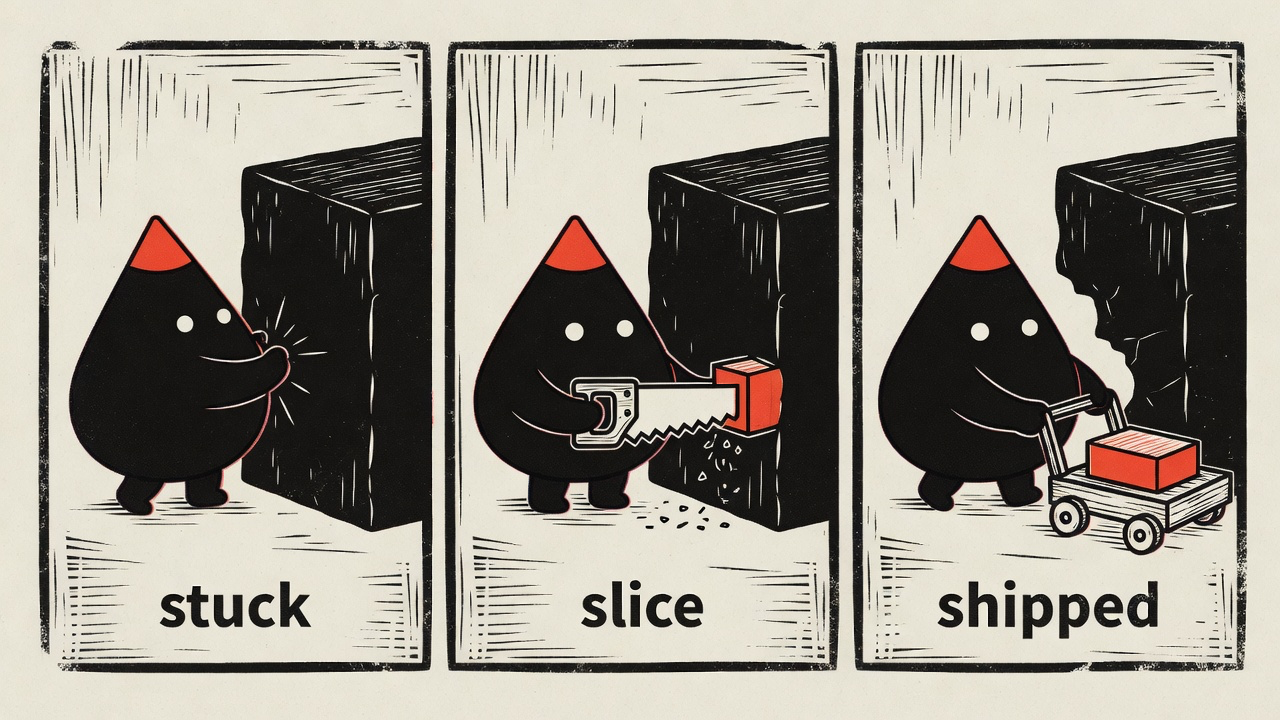
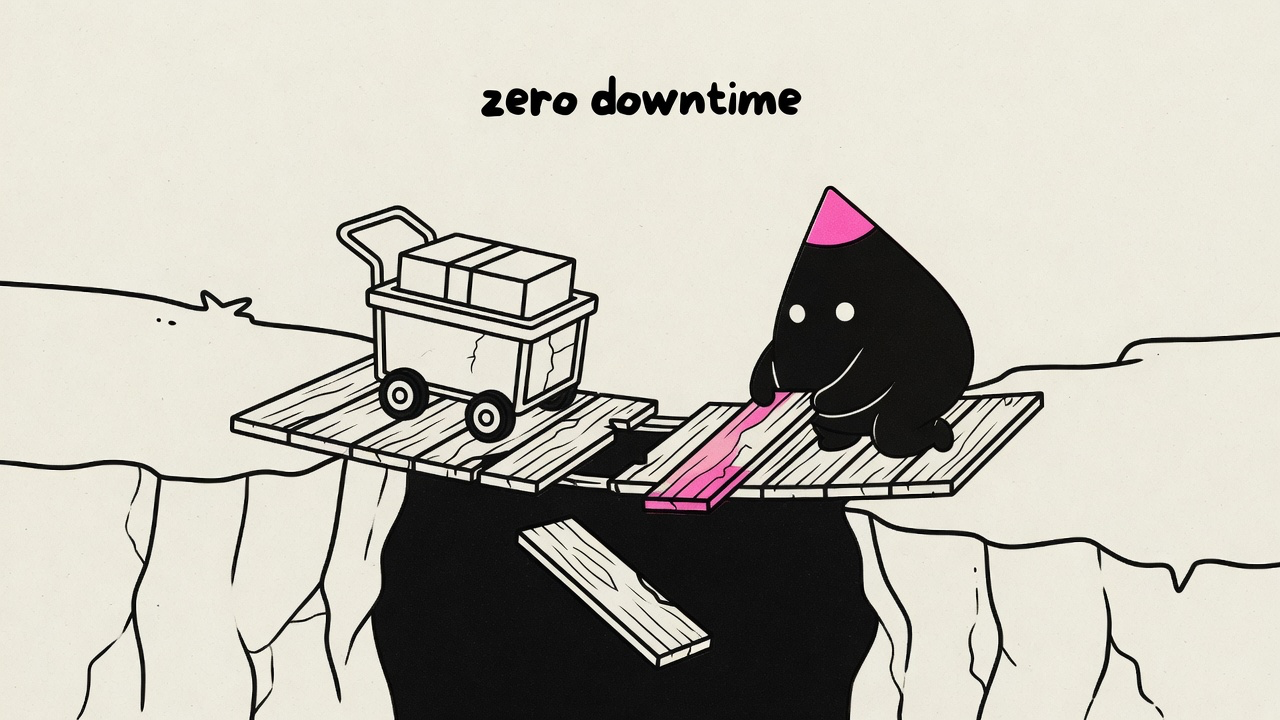
And the day job — compressing an abstract concept into one scene that lands
in about a second. Hand it *"we replatform with zero downtime"* and you get
the bridge being rebuilt under live traffic:
One idea per image, the mascot *performing* the move rather than decorating
it, a few short hand-lettered labels — every render is held to that
bar, and off-model results get re-rolled before you see them.
## Looks
Every character pack picks exactly one look from the bundled library:
| Look | The voice |
|---|---|
_meta.json
{
  "ownerId": "kn7ey3j7hw5sw95h24y5scayc57zz8rf",
  "slug": "illo",
  "version": "0.37.0",
  "publishedAt": 1790022053020
}
references/article-set-character-reroute.md
# Article-set character reroute

Use this gate when an article/newsletter set is being rerouted to a different
character after a weak or failed attempt, or whenever a new mascot/domain world
is introduced for a technical or platform essay. The expensive failure mode is
not bad drawing; it is a handsome set whose private metaphor system no longer
maps to the article.

## Mandatory legibility preflight

Before spending any renders, write a preflight row for every proposed shot:

- **Section claim** — the section-level thesis this image must land, in plain
  article language.
- **Visual object/action** — the one object and mascot action that will be
  visible in the frame.
- **Reader mapping** — how a reader gets from that object/action back to the
  section claim without seeing your notes.

Reject or rewrite the shot if the mapping needs either of these:

- a private metaphor glossary ("in this world, the cactus means infra debt");
- more than one conceptual substitution before the claim becomes clear.

One clean metaphor is allowed and often good. The test is whether the reader can
name it from the scene, not whether it is literal.

## Technical / platform essays

For technical, infrastructure, SaaS, protocol, or platform pieces, default the
core scene to native article primitives the reader already knows: accounts,
permissions, meters, tokens, gates, ledgers, switches, apps, providers, queues,
keys, quotas, bills, routes. Let the character pack's domain world supply the
accent, posture, and action — not the entire conceptual system.

Good reroute shape: the mascot pushes a permission gate, carries a token across
a provider switch, patches a leaky meter, or reconciles a ledger. Risky reroute
shape: every concept becomes a character-world object that must be decoded
before the article's claim can be read.

This is not a license to flatten the work into stock SaaS diagrams. Keep the
illo house style: one fresh physical move, one invented built object, quiet
space, and a load-bearing mascot. Avoid generic dashboards, formal charts,
UI mockups, and literal office art.

## Hero before style anchor

In a hero + set, the rerouted hero may become the style anchor only after it
passes both gates:

1. **Visual quality** — normal quality bar: on-model mascot, palette, restraint,
   composition, no artifact/title failures.
2. **Thesis legibility** — a reader can connect the scene to the piece's central
   claim without a private glossary or a chain of substitutions.

A visually strong but illegible hero is not a safe second reference; it will
propagate the wrong metaphor into the whole set.

## Explainer mode and labels

Explainer register is valid for multi-image article sets when a section needs a
traceable structure. Technical sections often become more legible as labeled
stages, flow, fan-out, timeline, loop, stack, or system slice than as a pure
editorial scene.
Keep it hand-built and character-led, not a formal flowchart.

Labels and titles are not forb
references/backends.md
# Backends and transports

illo has **three engine backends** plus one named **agent-side transport**. All
produce the same kind of file; they differ in where the image is made, how the
agent reaches it, and who is billed.

- **Codex** — drives the user's already-installed, already-logged-in **Codex
  CLI** (`codex exec`) to reach its built-in `image_generation` tool
  (gpt-image-2). Free for Codex subscribers (no per-image charge); it draws
  on the user's Codex usage quota.
- **Grok CLI** — drives the user's **Grok (xAI) CLI** (`grok -p`, its headless
  single-turn mode) to reach its built-in `image_gen`/`image_edit` tools. Free
  for Grok subscribers; draws on the user's Grok usage quota. Same env-free,
  token-free subprocess design as Codex. **Cannot produce transparent cutouts**
  (Grok returns JPEG with no alpha) — cutout renders redirect to a
  cutout-capable backend.
- **Grok Bot native** — when the agent is **Grok Bot** (Cursor's Grok Bot /
  the Grok desktop assistant), the agent persists `backend: grok-bot` with
  `init --backend grok-bot --no-key`, then calls Grok Bot's built-in Grok image
  tool directly with illo's prompt and reference image. This is the same Grok
  image-model class as the CLI backend, but a different harness: no Grok CLI and
  no OpenRouter key. It is not a generic "any host image API" escape hatch.
- **OpenRouter** — calls OpenRouter's image API directly. Pay-per-image
  through the user's OpenRouter account. The direct paid backend and the only
  engine backend a host without a subscription CLI can use. A failed CLI render
  reaches it only when `--allow-paid-fallback` is explicitly supplied;
  intentional cutout routing is unchanged.

`--backend` (and config `backend:`) selects an engine backend or the explicit
agent-side `grok-bot` transport; otherwise the engine resolves the right engine
backend by host capability. Resolution and readiness are reported by `doctor`.
`illo.py generate` refuses `grok-bot` because only the Grok Bot agent can call
its native image tool.

## Engine resolution and default (capability-aware)

The backend is resolved per run, never a static flip:

```
--backend  >  config backend:  >  capability-aware engine default
```

The **capability-aware engine default** is, in order:

1. a **usable Codex CLI** is present → `codex`;
2. else a **usable Grok CLI** is present → `grok`;
3. else an **OpenRouter key** is configured → `openrouter`;
4. else none → onboarding (the engine names the fixes).

This never silently breaks an existing OpenRouter-only install on upgrade: a
host with a key but no subscription CLI still resolves to `openrouter`, so
`doctor` stays exit 0. `grok-bot` is never auto-detected; the Grok Bot agent
self-identifies by running `init --backend grok-bot --no-key`. An explicit
`--backend`/`backend:` choice is honored as-is; readiness is judged separately,
so `doctor` can flag a chosen-but-unusable backend or green-light `grok-bot`.

### The self-identify rule (agent-driven, n
AionUi
Free, local, open-source 24/7 Cowork app and OpenClaw for Gemini CLI, Claude Code, Codex, OpenCode, Qwen Code, Goose CLI, Auggie, and more | 🌟 Star if you like it!
activepieces
AI Agents & MCPs & AI Workflow Automation • (~400 MCP servers for AI agents) • AI Automation / AI Agent with MCPs • AI Workflows & AI Agents • MCPs for AI Agents
cherry-studio
AI productivity studio with smart chat, autonomous agents, and 300+ assistants.
CopilotKit
The Frontend for Agents & Generative UI. React + Angular
Machine-readable data
The same record, as JSON, for agents and crawlers.
{
  "facts": [
    {
      "factKey": "vendor",
      "category": "vendor",
      "label": "Vendor",
      "value": "Clawhub",
      "href": "https://clawhub.ai/tmchow/skills/illo",
      "sourceUrl": "https://clawhub.ai/tmchow/skills/illo",
      "sourceType": "profile",
      "confidence": "medium",
      "observedAt": "2026-10-09T09:56:01.893Z",
      "isPublic": true
    },
    {
      "factKey": "protocols",
      "category": "compatibility",
      "label": "Protocol compatibility",
      "value": "OpenClaw",
      "href": "https://www.xpersona.co/api/v1/agents/clawhub-tmchow-illo/contract",
      "sourceUrl": "https://www.xpersona.co/api/v1/agents/clawhub-tmchow-illo/contract",
      "sourceType": "contract",
      "confidence": "medium",
      "observedAt": "2026-10-09T09:56:01.893Z",
      "isPublic": true
    },
    {
      "factKey": "traction",
      "category": "adoption",
      "label": "Adoption signal",
      "value": "3.1K downloads",
      "href": "https://clawhub.ai/tmchow/illo",
      "sourceUrl": "https://clawhub.ai/tmchow/illo",
      "sourceType": "profile",
      "confidence": "medium",
      "observedAt": "2026-10-09T09:56:01.893Z",
      "isPublic": true
    },
    {
      "factKey": "latest_release",
      "category": "release",
      "label": "Latest release",
      "value": "0.37.0",
      "href": "https://clawhub.ai/tmchow/illo",
      "sourceUrl": "https://clawhub.ai/tmchow/illo",
      "sourceType": "release",
      "confidence": "medium",
      "observedAt": "2026-09-21T20:20:53.020Z",
      "isPublic": true
    },
    {
      "factKey": "handshake_status",
      "category": "security",
      "label": "Handshake status",
      "value": "UNKNOWN",
      "href": "https://www.xpersona.co/api/v1/agents/clawhub-tmchow-illo/trust",
      "sourceUrl": "https://www.xpersona.co/api/v1/agents/clawhub-tmchow-illo/trust",
      "sourceType": "trust",
      "confidence": "medium",
      "observedAt": null,
      "isPublic": true
    }
  ],
  "events": [
    {
      "eventType": "release",
      "title": "Release 0.37.0",
      "description": "## [0.37.0](https://github.com/tmchow/illo-skill/compare/v0.36.0...v0.37.0) (2026-09-21) ### Features * add Muse native image transport ([#76](https://github.com/tmchow/illo-skill/issues/76)) ([e26efee](https://github.com/tmchow/illo-skill/commit/e26efee664965b1408bc5a4bdcb5b08cdc0e97dd))",
      "href": "https://clawhub.ai/tmchow/illo",
      "sourceUrl": "https://clawhub.ai/tmchow/illo",
      "sourceType": "release",
      "confidence": "medium",
      "observedAt": "2026-09-21T20:20:53.020Z",
      "isPublic": true
    }
  ]
}
Record generated Oct 9, 2026.