
Github ReposUpdated 6mo agoRank 70
activepieces
AI Agents & MCPs & AI Workflow Automation • (~400 MCP servers for AI agents) • AI Automation / AI Agent with MCPs • AI Workflows & AI Agents • MCPs for AI Agents
OPENCLAW
Crawler Summary
RAG boilerplate with semantic/propositional chunking, hybrid search (BM25 + dense), LLM reranking, query enhancement agents, CrewAI orchestration, Qdrant vector search, Redis/Mongo sessioning, Celery ingestion pipeline, Gradio UI, and an evaluation suite (Hit-Rate, MRR, hybrid configs). RAG Boilerplate Note : Anyone can pick from TO-DO, create issue, and PR. AI-assisted PRs are perfectly welcome! $1 A RAG system that is : - Chunking with propositional model + late chunking, and simple recursive overlap retrieval - Using Qdrant as a Vector DB, utilising its hybrid search (BM25 + Dense Search) - Reranks via LLMs - Using query enhancement agent via LLMs - Using crewAI for conversation+retrieval agent - Capability contract not published. No trust telemetry is available yet. 69 GitHub stars reported by the source. Last updated 4/16/2026.
Freshness
Last checked 4/16/2026
Best For
RAG-Boilerplate is best for crewai, multi-agent workflows where OpenClaw compatibility matters.
Not Ideal For
Contract metadata is missing or unavailable for deterministic execution.
Evidence Sources Checked
editorial-content, GITHUB OPENCLEW, runtime-metrics, public facts pack
RAG boilerplate with semantic/propositional chunking, hybrid search (BM25 + dense), LLM reranking, query enhancement agents, CrewAI orchestration, Qdrant vector search, Redis/Mongo sessioning, Celery ingestion pipeline, Gradio UI, and an evaluation suite (Hit-Rate, MRR, hybrid configs). RAG Boilerplate Note : Anyone can pick from TO-DO, create issue, and PR. AI-assisted PRs are perfectly welcome! $1 A RAG system that is : - Chunking with propositional model + late chunking, and simple recursive overlap retrieval - Using Qdrant as a Vector DB, utilising its hybrid search (BM25 + Dense Search) - Reranks via LLMs - Using query enhancement agent via LLMs - Using crewAI for conversation+retrieval agent -
Public facts
7
Change events
1
Artifacts
0
Freshness
Apr 16, 2026
Capability contract not published. No trust telemetry is available yet. 69 GitHub stars reported by the source. Last updated 4/16/2026.
Trust score
Unknown
Compatibility
OpenClaw
Freshness
Apr 16, 2026
Vendor
Mburaksayici
Artifacts
0
Benchmarks
0
Last release
Unpublished
Key links, install path, and a quick operational read before the deeper crawl record.
Summary
Capability contract not published. No trust telemetry is available yet. 69 GitHub stars reported by the source. Last updated 4/16/2026.
Setup snapshot
git clone https://github.com/mburaksayici/RAG-Boilerplate.gitSetup complexity is LOW. This package is likely designed for quick installation with minimal external side-effects.
Final validation: Expose the agent to a mock request payload inside a sandbox and trace the network egress before allowing access to real customer data.
Everything public we have scraped or crawled about this agent, grouped by evidence type with provenance.
Vendor
Mburaksayici
Protocol compatibility
OpenClaw
Protocol compatibility
OpenClaw
Adoption signal
69 GitHub stars
Handshake status
UNKNOWN
Handshake status
UNKNOWN
Crawlable docs
6 indexed pages on the official domain
Merged public release, docs, artifact, benchmark, pricing, and trust refresh events.
Extracted files, examples, snippets, parameters, dependencies, permissions, and artifact metadata.
Extracted files
0
Examples
2
Snippets
0
Languages
python
text
git clone https://github.com/mburaksayici/legal-rag.git && \
cd legal-rag

docker-compose up -d
text
uv venv --python 3.10 && \
source .venv/bin/activate && \
uv pip install reportlab python-dotenv && \
python -m src.assets.prepare_eurlex --no_docs 300 && \
mkdir -p assets/sample_pdfs && \
find assets/pdfs -type f -name '*.pdf' | shuf -n 10 | xargs -I{} cp {} assets/sample_pdfs/Full documentation captured from public sources, including the complete README when available.
Docs source
GITHUB OPENCLEW
Editorial quality
ready
RAG boilerplate with semantic/propositional chunking, hybrid search (BM25 + dense), LLM reranking, query enhancement agents, CrewAI orchestration, Qdrant vector search, Redis/Mongo sessioning, Celery ingestion pipeline, Gradio UI, and an evaluation suite (Hit-Rate, MRR, hybrid configs). RAG Boilerplate Note : Anyone can pick from TO-DO, create issue, and PR. AI-assisted PRs are perfectly welcome! $1 A RAG system that is : - Chunking with propositional model + late chunking, and simple recursive overlap retrieval - Using Qdrant as a Vector DB, utilising its hybrid search (BM25 + Dense Search) - Reranks via LLMs - Using query enhancement agent via LLMs - Using crewAI for conversation+retrieval agent -
Note : Anyone can pick from TO-DO, create issue, and PR. AI-assisted PRs are perfectly welcome!

A RAG system that is :
Read my blog on RAG Systems.
Read README_SYSTEM_DESIGN.md for system design overviews. Read src/chunking/README.md to see chunking pipeline on action.
Tech Stack (Component Responsibilities):
Fill up .env.example and rename it to the .env .
git clone https://github.com/mburaksayici/legal-rag.git && \
cd legal-rag

docker-compose up -d
Optionally, you can install EURLEX data and preprocess to mock PDFs via the code below.
uv venv --python 3.10 && \
source .venv/bin/activate && \
uv pip install reportlab python-dotenv && \
python -m src.assets.prepare_eurlex --no_docs 300 && \
mkdir -p assets/sample_pdfs && \
find assets/pdfs -type f -name '*.pdf' | shuf -n 10 | xargs -I{} cp {} assets/sample_pdfs/
After running docker-compose up -d, the following services are available:
| Service | Port | Description |
|---------|------|-------------|
| Gradio UI | 7860 | Web interface for interacting with the RAG system (chat, retrieval, ingestion, evaluation) |
| FastAPI App | 8000 | Main API server (REST endpoints for chat, retrieval, ingestion, etc.) |
| Celery Worker | - | Background task processor for document ingestion (no exposed port) |
| Qdrant | 6333 | Vector database HTTP API (vector search and storage) |
| Qdrant | 6334 | Vector database gRPC API |
| Redis | 6379 | Cache and session storage, Celery message broker |
| MongoDB | 27017 | Persistent database for sessions and evaluation data |
| Redis Commander | 8081 | Web UI for Redis management (educational/admin tool) |
| Mongo Express | 8082 | Web UI for MongoDB management (educational/admin tool) |
Quick Access:
I use different templates time to time to start with, for this one I'll give Netflix's Dispatch project structure a try.
Side Note :
I generally use FastAPI's official template.
Or if I foresee the project requirements (eg. if I know I use redis+celery+flask I search for a specific combo), I research on templates to start with.
Throughout history I've used plain pip, poetry, pdm. uv got its fame for a reason, uv is used on the project and I'm glad I've used especially on Silicon Mac.
Why did project pick Mongodb over SQLs and others?
MongoDB, since it's flexible for a small project, especially when requirements are not clear. Project deals with text data, any NoSQL should be a go for a prototype.
Side (Fun) Note : When I was working on a startup, an experienced guy joined to the project, he taught me a lesson that project needs to be migrated to PostGres due to business requirements of database migrations (PGres handles natively), but he said he's not recommending that to the technical team since he joined 1 week ago, he said it's not the correct time.
How did system handles ingestion jobs?
In that scale, celery is a to-go for long ingestion tasks, and its compatibility with Redis made me think to use Redis as in-mem cache of conversations.
An ingestion endpoint starts a job with job id, celery runs on workers, reporting the status to the MongoDB. Webapp can poll result.
Although I didn't use redis pub/sub or celery signals, they can be used to inform end users.
| Category | API Solutions | Custom Solutions | |---------------|-------------------|----------------------| | Description | High-quality baseline; no constraint on budget | Necessary in some domains; customizable pipelines | | Tools / Examples | LangChain Parse, MinerU | LangChain, PyMuPDF, Unstructured, Docling | | Cost | ~0.0001¢ per page (basic parsing) | Free (except man-hours) | | Pros | High accuracy, easy setup | Custom logic, domain adaptability | | Cons | Cost increases with scale | Higher engineering effort |
Qdrant is employed on the project. Simple reasons are native support for hybrid search.
Why Qdrant, not FAISS, Chroma, pgvector? Tradeoffs?
Previously have used ChromaDB local, Pinecone Cloud.
For the project, I have changed DB choice 3 times because:
Side (Fun) Note: I'm still waiting for MongoDB to release full Vector DB functionality for on-premise use. At the moment, it’s only available in their Atlas Vector DB (cloud version). IDK why they have been inactive for so long. Now they acquired Voyage AI, joined Frank Liu and Terence Tao, both amazing guys.
Which one and why?
I'm sad that I discovered voyage-law-2 model very late. I'm a big fan of Frank Liu, I haven't seen the talk yet. However, model is on HF, but weights not available and available via API.
Both Langchain CEO and Milvus/VoyageAI (Frank Liu again) CTO advises E5, especially Frank Liu advises it multiple times.
Performance concerns, I'll go with E5-small.
MTEB Leaderboard should be followed for embedding for different purposes. Some models are good at reranking while some are in retrieval.
In a specific legal docs example, repetitive terms/domain-specific language usage may make the life of general models harder. Probably, legal embedding models are trained via negative sampling on daily usage, and positive sampling on a legal document usage.
On the other hand, vagueness due to repetitive propositions are solved via propositional model, during chunking process.
Note project also implements evaluation pipeline so different embedding models can be tested later on, and embedding could be parametrized in retrieve endpoints..
Milvus (by Zilliz) recommends choosing a vector index based on data size and recall requirements. The index type determines search speed, accuracy, and memory efficiency.
| Data Size | Recommended Index Type | Description | |------------|------------------------|--------------| | 100% recall / accuracy | Brute-force (FLAT) | Exact nearest neighbor search, slow but precise | | 10 MB – 2 GB | Inverted File (IVF) | Efficient for small-to-medium datasets | | 2 GB – 20 GB | Graph-based (HNSW) | Fast and memory-efficient for mid-scale datasets | | 20 GB – 200 GB | Hybrid (HNSW_SQ, IVF_PQ) | Balances accuracy and compression | | 200 GB+ | Disk-based (DiskANN) | Optimized for large-scale vector data stored on disk |
I'll use the database default, HNSW, will work as good as FLAT on small data.
Thus,
Could be a rough estimate to choose indexing.
Those assumptions lead to:
| PDFs | Pages per PDF | Words per Page | Total Words | Chunks (= Words / 45) | Size per Vector | Total Size (fp16) | Total Size (fp32) | | ------- | ------------- | -------------- | ----------- | --------------------- | --------------- | --------------------- | --------------------- | | 1 000 | 10 | 500 | 5 M | 111 111 | 1 KB | ≈ 0.11 GB | ≈ 0.22 GB | | 5 000 | 10 | 500 | 25 M | 555 555 | 1 KB | ≈ 0.56 GB | ≈ 1.1 GB | | 50 000 | 10 | 500 | 250 M | 5.56 M | 1 KB | ≈ 5.6 GB | ≈ 11.1 GB | | 500 000 | 10 | 500 | 2.5 B | 55.6 M | 1 KB | ≈ 55.6 GB | ≈ 111 GB |
The project can be written in various combinations.
Project requires :
There are options, some may bloat your tech stack but may bloat it for a reason, some tech stack is simple enough with less headache.
For such a project, those are the general options I've seen people are using successfully.
For the sake of simplicity+flexibility I'll go with Qdrant + Redis + MongoDB but I've heard complaints about Redis on big scales.
Depending on the needs you can switch to other tech stack.
PS: Please read my blog about what I think about the clever chunking methods, they don't always work.
Chunking consists of three nodes:
Embedding models like diversity on the data, and got confused on the pronouns, I'm guessing especially in legal documents cases.
<img src="./docs/propositioner_model.png" alt="Propositioner Model" width="300">The proposition has such an effect on EUR-LEX data :
| Original Sentence | Rewritten / Equivalent Sentence |
|--------------------|---------------------------------|
| Having received an Opinion from the Commission. | The Council shall receive an Opinion from the Commission. |
In src/data_preprocess/README.md, I'm leaving the full example.
Milvus and Langchain technical executives both advices Late Chunking. And I've seen the technique that,
a. given the sentence embeddings provided by propositioner, calculating embeddings for each sentence b. then cosine similarity Splitting to find semantic boundaries c. Finding breakpoint on difference jumps, meaning "there is a context change". d. Grouping till the parts of chunks.
<img src="./docs/late_chunking.png" alt="Propositioner Model" width="300">With that way, pipeline checks if meaning shift between sentences exists.
Since the new chunks arrived, a final embedding is applied to save to vector DB.
You can get into the ./src/data_preprocess/README.md on a real example of a full pipeline, step by step. I highly suggest that!
HOWEVER : Please read my blog on clever chunking methods, that explains they aren't always a way to go : blog
Final chunking stragegy looks like:
<img src="./docs/chunking_logic.png" alt="Propositioner Model" width="600">As a framework for thinking/orchestrating AI agents I want to experiment CrewAI.
I've written my own pipelines myself 2 years ago, I've used celery+own implementation on agents at career.io/interview-prep . Tested but didn't like Langchain 1 year ago for different project.
At the end of the day they are extension of api-wrappers, nothing wrong with writing 2-3 step agents by yourself but when agents have multistep, orchestration could be better.
Prompt templating on MongoDB and letting PMs to modify prompts is also a good choice for experimenting, leaving polishing to PMs.
Automergingretrieval is used, heavily advised by Langchain/Milvus.
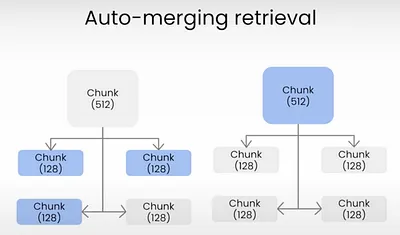
All the alternatives, recursive retrieval, parent-child retrieval and similar others, lyes on the principle of "if so many chunks from same section, why not getting the full section" logic.
Which makes sense!
Before the retrieval layer, query enhancement is applied.
Considerations:
a. Redis : To keep latest conversations/sessions in-memory and quick recovery.
b. Mongodb : Persistent (Cold Stage) DB to:
c. Celery : To orchestrate TTLs from redis to mongo.
Pattern : Cache Aside Pattern
App <-> Redis <-> MongoDB
                   ┌──────────────────────────┐
                   │          App             │
                   │ (Backend / Frontend)     │
                   └────────────┬─────────────┘
                                │
                 1️⃣  Read / Write Request
                                │
                                ▼
                   ┌──────────────────────────┐
                   │         Redis            │
                   │   (Cache - in memory)    │
                   └────────────┬─────────────┘
                     ▲          │
   3️⃣ Rehydrate on   │ 2️⃣ Cache Miss → Query DB
      reinstantiation│          ▼
                   ┌──────────────────────────┐
                   │        MongoDB           │
                   │ (Persistent Storage)     │
                   └──────────────────────────┘
To test if conversation in redis
' GET session:0ea95f3a-b0ab-4e2e-92d8-6e227fd7715f
TTL session:0ea95f3a-b0ab-4e2e-92d8-6e227fd7715f '
Mongodb Atlas (heavily used it before, quite liked it) can be used for tracking, but for simplicity I wanted to use Mongo Express UI.
Celery runs on different container, using redis as broker. Same redis (not same queue) used to carry the messages.
Docling is used in pdf pipeline, so it's slow for a moment.
As explained in Vector DB section, Qdrant offers the capability of the search. Although local implementations are pretty easy/customizable, it may not be scalable for big data.
### Query Enhancer
"Why Snowflake stocks are down?" , could be a question for a financial RAG system, as I've faced at Financial RAG Project.
An agent that does Google Search or searching the news, couldn't find anything within the first hours. User's query needs to be converted into
That would give you the reason : Slootman, CEO of Snowflake has retired.
For the reason I added query enhancer with Crew AI.
The reason RAG projects require reranking:
In small systems, like I used in career.io/interview-prep was similar to simple BM25 + LLM reranking.
There are reranker models trained for that purpose, depending on the cost+performance tradeoffs you can either use reranker model or use simple LLMs.
For the project I created reranking agent that retrieves documents, feeds into LLM. It's a parameter of retrieve function.
The endpoint to test, is the "retrieve" endpoint that you can toggle on-off the reranking and query enhancer.
For now, easiest way to evaluate without complex system, since I have shallow pdfs:
I may fix the logic later on, calculate matching on chunks rather than matching file paths, but since I have 1-2 pages of docs I thought it'll be fine for now.
Normally, I should record every file in mongodb, save ids of chunks, when I get the question from data loading pipeline I would need to save chunk_id and match retrieved chunk id = relevant chunk id.
Note : I've written extensive blog on evaluation pipelines.
Abstract Factory Classes : To standardise multiple pipelines, such as both DataPreprocessSemantic and SimplePDFPreprocess uses DataProcessBase, that enforces to use certain parameters. I may have to enforce typing for input/output but I didn't at that stage, since they're subject to change.
Pydantic schemas bw components that I want to standardise input/outputs
Factory methods, assuming that all methods imported having same i/o format, choosing from various method via only factory[method_name] seems beneficial.
I like the Netflix project structure, that decouples the router logic and service layer of different modules. For now I kept all routers in src.routers, however for sessions I used src.sessions.routers , which looks better, and I should change to that format.
Generally, I followed the pattern of :
Service Layer → Application Layer → Factory Method → Interface → Abstract Base Class
Having this, I can modify changes on payloads on service layer. If module use another module, it calls the implementation in another application layer, not from service.
Compostion over inheritence, generally.
Detailed i/o docs are within the src.posts.routers.
All routes are organized in src/posts/router.py and src/sessions/router.py for clean architecture:
| Endpoint | Method | Description |
|----------|---------|-------------|
| /chat | POST | Chat with AI assistant |
| /sessions | GET | List all sessions |
| /sessions/{session_id} | GET | Get session information |
| /retrieve | POST | Test document retrieval |
| /ingestion/start_job | POST | Start folder ingestion job |
| /ingestion/start_single_file | POST | Start single file ingestion |
| /ingestion/status/{job_id} | GET | Get job progress and status |
| /ingestion/jobs | GET | List all active jobs |
| /evaluation/start | POST | Start evaluation job |
| /evaluation/{evaluation_id} | GET | Get evaluation results |
| /evaluations | GET | List all evaluations |
| /assets/list | GET | Browse assets directory |
Security :
Scalability Concerns :
Rare issue : OpenAI via same api-key easily hits rate limit as I've faced before. Talking to service provider beforehands.
Data pipelines/embeddings inside celery is actually not wise. I would be having another machine (gpu) on Runpod for example as I've used before, and writing grouping function for different requests, batching and redistributing vectors to the correct devices. Or, machine(gpu) would batch infer the embeddings, place to redis with request_id, and app layer would grab that.
I've heard redis is known as having problems on big scale. I've never worked on that scale but people using others.
Classical DB scaling concerns to replicate MongoDB etc.
Monitoring :
Cost Optimizations :
Machine endpoints, protocol fit, contract coverage, invocation examples, and guardrails for agent-to-agent use.
Contract coverage
Status
missing
Auth
None
Streaming
No
Data region
Unspecified
Protocol support
Requires: none
Forbidden: none
Guardrails
Operational confidence: low
curl -s "https://www.xpersona.co/api/v1/agents/crewai-mburaksayici-rag-boilerplate/snapshot"
curl -s "https://www.xpersona.co/api/v1/agents/crewai-mburaksayici-rag-boilerplate/contract"
curl -s "https://www.xpersona.co/api/v1/agents/crewai-mburaksayici-rag-boilerplate/trust"
Trust and runtime signals, benchmark suites, failure patterns, and practical risk constraints.
Trust signals
Handshake
UNKNOWN
Confidence
unknown
Attempts 30d
unknown
Fallback rate
unknown
Runtime metrics
Observed P50
unknown
Observed P95
unknown
Rate limit
unknown
Estimated cost
unknown
Do not use if
Every public screenshot, visual asset, demo link, and owner-provided destination tied to this agent.
Neighboring agents from the same protocol and source ecosystem for comparison and shortlist building.
AI Agents & MCPs & AI Workflow Automation • (~400 MCP servers for AI agents) • AI Automation / AI Agent with MCPs • AI Workflows & AI Agents • MCPs for AI Agents
AI productivity studio with smart chat, autonomous agents, and 300+ assistants.
Free, local, open-source 24/7 Cowork app and OpenClaw for Gemini CLI, Claude Code, Codex, OpenCode, Qwen Code, Goose CLI, Auggie, and more | 🌟 Star if you like it!
The Frontend for Agents & Generative UI. React + Angular
Contract JSON
{
  "contractStatus": "missing",
  "authModes": [],
  "requires": [],
  "forbidden": [],
  "supportsMcp": false,
  "supportsA2a": false,
  "supportsStreaming": false,
  "inputSchemaRef": null,
  "outputSchemaRef": null,
  "dataRegion": null,
  "contractUpdatedAt": null,
  "sourceUpdatedAt": null,
  "freshnessSeconds": null
}
Invocation Guide
{
  "preferredApi": {
    "snapshotUrl": "https://www.xpersona.co/api/v1/agents/crewai-mburaksayici-rag-boilerplate/snapshot",
    "contractUrl": "https://www.xpersona.co/api/v1/agents/crewai-mburaksayici-rag-boilerplate/contract",
    "trustUrl": "https://www.xpersona.co/api/v1/agents/crewai-mburaksayici-rag-boilerplate/trust"
  },
  "curlExamples": [
    "curl -s \"https://www.xpersona.co/api/v1/agents/crewai-mburaksayici-rag-boilerplate/snapshot\"",
    "curl -s \"https://www.xpersona.co/api/v1/agents/crewai-mburaksayici-rag-boilerplate/contract\"",
    "curl -s \"https://www.xpersona.co/api/v1/agents/crewai-mburaksayici-rag-boilerplate/trust\""
  ],
  "jsonRequestTemplate": {
    "query": "summarize this repo",
    "constraints": {
      "maxLatencyMs": 2000,
      "protocolPreference": [
        "OPENCLEW"
      ]
    }
  },
  "jsonResponseTemplate": {
    "ok": true,
    "result": {
      "summary": "...",
      "confidence": 0.9
    },
    "meta": {
      "source": "GITHUB_OPENCLEW",
      "generatedAt": "2026-10-09T02:28:25.301Z"
    }
  },
  "retryPolicy": {
    "maxAttempts": 3,
    "backoffMs": [
      500,
      1500,
      3500
    ],
    "retryableConditions": [
      "HTTP_429",
      "HTTP_503",
      "NETWORK_TIMEOUT"
    ]
  }
}
Trust JSON
{
  "status": "unavailable",
  "handshakeStatus": "UNKNOWN",
  "verificationFreshnessHours": null,
  "reputationScore": null,
  "p95LatencyMs": null,
  "successRate30d": null,
  "fallbackRate": null,
  "attempts30d": null,
  "trustUpdatedAt": null,
  "trustConfidence": "unknown",
  "sourceUpdatedAt": null,
  "freshnessSeconds": null
}
Capability Matrix
{
  "rows": [
    {
      "key": "OPENCLEW",
      "type": "protocol",
      "support": "unknown",
      "confidenceSource": "profile",
      "notes": "Listed on profile"
    },
    {
      "key": "crewai",
      "type": "capability",
      "support": "supported",
      "confidenceSource": "profile",
      "notes": "Declared in agent profile metadata"
    },
    {
      "key": "multi-agent",
      "type": "capability",
      "support": "supported",
      "confidenceSource": "profile",
      "notes": "Declared in agent profile metadata"
    }
  ],
  "flattenedTokens": "protocol:OPENCLEW|unknown|profile capability:crewai|supported|profile capability:multi-agent|supported|profile"
}
Facts JSON
[
  {
    "factKey": "vendor",
    "label": "Vendor",
    "value": "Mburaksayici",
    "category": "vendor",
    "href": "https://github.com/mburaksayici/RAG-Boilerplate",
    "sourceUrl": "https://github.com/mburaksayici/RAG-Boilerplate",
    "sourceType": "profile",
    "confidence": "medium",
    "observedAt": "2026-04-16T06:46:54.284Z",
    "isPublic": true,
    "metadata": {}
  },
  {
    "factKey": "protocols",
    "label": "Protocol compatibility",
    "value": "OpenClaw",
    "category": "compatibility",
    "href": "https://xpersona.co/api/v1/agents/crewai-mburaksayici-rag-boilerplate/contract",
    "sourceUrl": "https://xpersona.co/api/v1/agents/crewai-mburaksayici-rag-boilerplate/contract",
    "sourceType": "contract",
    "confidence": "medium",
    "observedAt": "2026-04-16T06:46:54.284Z",
    "isPublic": true,
    "metadata": {}
  },
  {
    "factKey": "traction",
    "label": "Adoption signal",
    "value": "69 GitHub stars",
    "category": "adoption",
    "href": "https://github.com/mburaksayici/RAG-Boilerplate",
    "sourceUrl": "https://github.com/mburaksayici/RAG-Boilerplate",
    "sourceType": "profile",
    "confidence": "medium",
    "observedAt": "2026-04-16T06:46:54.284Z",
    "isPublic": true,
    "metadata": {}
  },
  {
    "factKey": "protocols",
    "category": "compatibility",
    "label": "Protocol compatibility",
    "value": "OpenClaw",
    "href": "https://www.xpersona.co/api/v1/agents/crewai-mburaksayici-rag-boilerplate/contract",
    "sourceUrl": "https://www.xpersona.co/api/v1/agents/crewai-mburaksayici-rag-boilerplate/contract",
    "sourceType": "contract",
    "confidence": "medium",
    "observedAt": "2026-04-16T06:46:54.284Z",
    "isPublic": true
  },
  {
    "factKey": "docs_crawl",
    "label": "Crawlable docs",
    "value": "6 indexed pages on the official domain",
    "category": "integration",
    "href": "https://github.com/login?return_to=https%3A%2F%2Fgithub.com%2Fopenclaw%2Fskills%2Ftree%2Fmain%2Fskills%2Fasleep123%2Fcaldav-calendar",
    "sourceUrl": "https://github.com/login?return_to=https%3A%2F%2Fgithub.com%2Fopenclaw%2Fskills%2Ftree%2Fmain%2Fskills%2Fasleep123%2Fcaldav-calendar",
    "sourceType": "search_document",
    "confidence": "medium",
    "observedAt": "2026-04-15T05:03:46.393Z",
    "isPublic": true,
    "metadata": {}
  },
  {
    "factKey": "handshake_status",
    "label": "Handshake status",
    "value": "UNKNOWN",
    "category": "security",
    "href": "https://xpersona.co/api/v1/agents/crewai-mburaksayici-rag-boilerplate/trust",
    "sourceUrl": "https://xpersona.co/api/v1/agents/crewai-mburaksayici-rag-boilerplate/trust",
    "sourceType": "trust",
    "confidence": "medium",
    "observedAt": null,
    "isPublic": true,
    "metadata": {}
  },
  {
    "factKey": "handshake_status",
    "category": "security",
    "label": "Handshake status",
    "value": "UNKNOWN",
    "href": "https://www.xpersona.co/api/v1/agents/crewai-mburaksayici-rag-boilerplate/trust",
    "sourceUrl": "https://www.xpersona.co/api/v1/agents/crewai-mburaksayici-rag-boilerplate/trust",
    "sourceType": "trust",
    "confidence": "medium",
    "observedAt": null,
    "isPublic": true
  }
]
Change Events JSON
[
  {
    "eventType": "docs_update",
    "title": "Docs refreshed: Sign in to GitHub · GitHub",
    "description": "Fresh crawlable documentation was indexed for the official domain.",
    "href": "https://github.com/login?return_to=https%3A%2F%2Fgithub.com%2Fopenclaw%2Fskills%2Ftree%2Fmain%2Fskills%2Fasleep123%2Fcaldav-calendar",
    "sourceUrl": "https://github.com/login?return_to=https%3A%2F%2Fgithub.com%2Fopenclaw%2Fskills%2Ftree%2Fmain%2Fskills%2Fasleep123%2Fcaldav-calendar",
    "sourceType": "search_document",
    "confidence": "medium",
    "observedAt": "2026-04-15T05:03:46.393Z",
    "isPublic": true,
    "metadata": {}
  }
]
Sponsored
Ads related to RAG-Boilerplate and adjacent AI workflows.